Bedroom
Bed sizes: mattress size chart and how to choose


The short answer
Standard US mattress sizes are twin 38 x 75 in, twin XL 38 x 80 in, full 54 x 75 in, queen 60 x 80 in, king 76 x 80 in and California king 72 x 84 in. Queen is the most common choice for couples; king gives each sleeper the width of a twin XL. The bed frame adds several inches to every dimension.
Remember
- Queen: 60 x 80 in (152 x 203 cm), the most common size for couples.
- King: 76 x 80 in (193 x 203 cm), equal to two twin XLs side by side.
- California king: 72 x 84 in (183 x 213 cm), narrower but 4 in longer than a king.
- Leave 24 to 36 in of walkway on each side and at the foot of the bed.
- The frame and headboard add to the mattress size; check the bed's overall dimensions.
Contents
US mattress size chart
US mattress sizes are standardized. These are the nominal dimensions; actual mattresses can vary by about half an inch to an inch, and the bed frame adds more.
| Size | Inches (W x L) | Centimeters (approx.) | Best for |
|---|---|---|---|
| Twin | 38 x 75 | 97 x 191 | Children, bunk beds, small guest rooms |
| Twin XL | 38 x 80 | 97 x 203 | Teens and tall single sleepers, dorms |
| Full (double) | 54 x 75 | 137 x 191 | Single adults, guest rooms |
| Queen | 60 x 80 | 152 x 203 | Couples, single adults who want space |
| King | 76 x 80 | 193 x 203 | Couples who want more personal space, families who co-sleep |
| California king | 72 x 84 | 183 x 213 | Tall sleepers, longer and narrower rooms |
Two useful equivalences: a king is the same size as two twin XL mattresses side by side (2 x 38 = 76 in wide, both 80 in long), which is why split-king setups use two twin XLs. And a full is the same length as a twin but 16 in wider.
Mattress depth (thickness) is not standardized and typically ranges from about 8 to 14 in or more. Deeper mattresses need deeper fitted sheets and change the height of the bed, which matters for headboard proportions below.
Which bed size should you choose?
Start with who sleeps in the bed and how tall they are, then check the room.
- Width per person: a queen gives each of two sleepers 30 in, about the width of a crib mattress. A king gives each 38 in, the width of a twin. If either of you moves a lot, sleeps hot, or shares the bed with a child or pet, the extra width of a king is noticeable.
- Length: a 75 in twin or full is short for many adults over about 6 ft, since you want several inches of mattress beyond your head and feet. Queens and kings are 80 in long, and the California king adds another 4 in.
- King vs California king: the California king is 4 in narrower and 4 in longer. It suits tall sleepers and longer, narrower rooms. A standard king offers more total sleeping area (6,080 sq in vs 6,048 sq in) and more widely available bedding.
- Full vs queen: a full is fine for one adult. For two adults it gives each 27 in, which most couples find tight; a queen is the usual minimum for couples.
Moving matters too. Check that the box spring or foundation and the frame will fit through stairs, doors and corridors. Many king foundations come in two pieces for this reason.

Room size for each bed
A bed needs walkway space on each side used to get in and out, and at the foot. The usual guidance is 24 to 36 in (61 to 91 cm) of clear floor: 24 in is the workable minimum, 30 to 36 in is comfortable. Allow more where drawers or wardrobe doors open toward the bed.
| Bed | Mattress | Minimum room (24 in clearance) | Comfortable room (36 in clearance) |
|---|---|---|---|
| Twin | 38 x 75 in | 7.5 x 9 ft (against a wall: 6 x 9 ft) | 9.5 x 10 ft |
| Full | 54 x 75 in | 9 x 9 ft | 11 x 10 ft |
| Queen | 60 x 80 in | 9.5 x 9 ft | 11.5 x 10 ft |
| King | 76 x 80 in | 11 x 9 ft | 13 x 10 ft |
| California king | 72 x 84 in | 10.5 x 9.5 ft | 12.5 x 10.5 ft |
Room sizes are given as width (across the bed) by length, with clearance on both sides and at the foot, an allowance of about 4 in for the frame, and figures rounded up to the next half foot. Real beds are larger than their mattresses: frames typically add a few inches in width and length, and headboards and upholstered frames can add more. A wide or winged headboard can add significantly to the overall width, so always measure the bed's overall dimensions, not the mattress size.
Nightstands are typically 18 to 28 in wide. In a tight room, a queen with two narrow nightstands often works better than a king with none.
Clearance around the bed
- Sides: 24 to 36 in on each side where someone gets in. A guest bed pushed against a wall needs it on one side only.
- Foot: 24 to 36 in to the opposite wall or furniture. If a dresser faces the foot of the bed, allow about 36 in or more so you can open drawers and stand in front of them.
- Doors and windows: keep the door swing clear, and avoid placing the headboard where it blocks a window or a radiator if you can.
- Nightstands: place them with their top roughly level with the top of the mattress, or within a few inches, so a lamp and glass are easy to reach.
A rug under the bed should show about 18 to 24 in on each side and beyond the foot. Our rug size guide covers rug sizes for each bed.
Headboard height and proportion
Headboard height is measured from the floor. Typical heights range from roughly 40 to 60 in or more, but what matters is how much shows above the mattress and pillows, and how it relates to the wall.
- For sitting up in bed: the headboard should rise at least 10 to 12 in above the top of the mattress, and ideally high enough to support your shoulders and head. With a mattress top at about 24 to 26 in, that usually means a headboard of 48 in or more.
- Low headboards (under about 40 in) suit low platform beds, rooms with a window behind the bed, and minimal interiors.
- Tall headboards (55 to 65 in or more) make a statement and suit high ceilings and large rooms. In a room with 8 ft ceilings, they still work if the rest of the room is kept simple.
- Width: the headboard is usually as wide as the mattress plus a few inches. Wider, winged headboards frame the bed and the nightstands together.
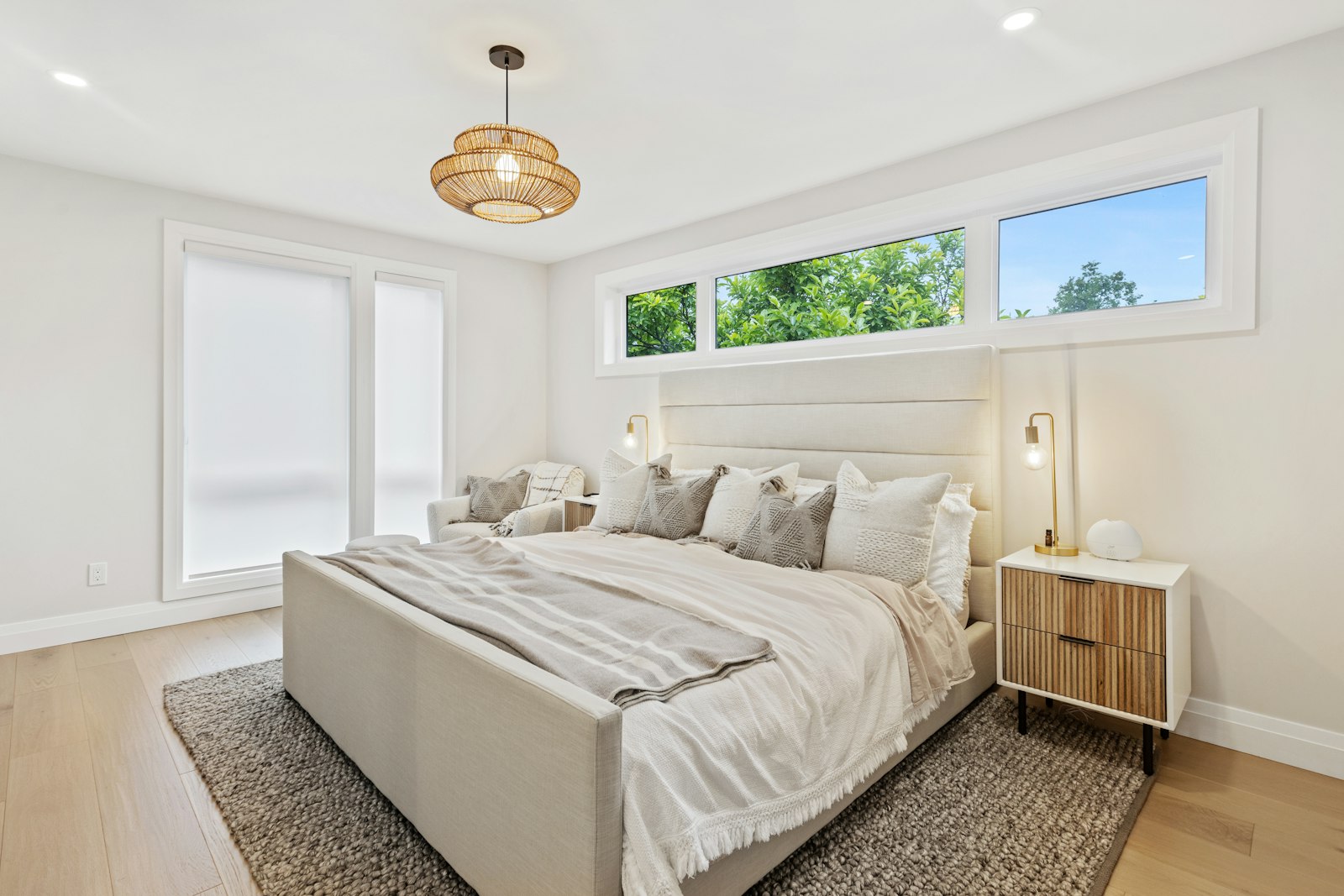
Upholstered headboards make sitting up in bed far more comfortable than wood or metal. The Sipario has a tall, channel-quilted upholstered headboard; the Ala has a wing headboard that wraps around the sleeper; and the Sogno pairs a channel headboard with USB rails, useful when outlets are far from the bed.
Bed height
Bed height is the distance from the floor to the top of the mattress. Most beds land around 20 to 25 in. A good rule: sitting on the edge of the bed, your feet should rest flat on the floor with knees at roughly a right angle. Lower beds look modern and make a room feel taller; higher beds are easier to get in and out of, which matters for anyone with stiff knees or hips.
The total height depends on the frame, the foundation, if any, and the mattress depth. A platform bed with a 10 in mattress may sit at about 18 to 22 in; a traditional frame with a box spring and a deep mattress can reach 25 in or more. If you change mattress, check that the new depth still leaves enough headboard showing.
International and specialty sizes
Bed sizes outside the US differ, and sheets and frames don't always cross over. European sizes are typically given in centimeters, with common double sizes such as 140 x 200 cm and 160 x 200 cm, and larger sizes such as 180 x 200 cm. They are close to, but not the same as, US full, queen and king. If you buy a bed made for one market, buy the mattress and bedding for the same standard.
In the US, you will also see the Olympic queen (66 x 80 in) and the Alaskan and Texas kings, which are less common and harder to find bedding for. For most homes, the six standard sizes in the chart above cover every need.
Browse beds and the Editions bedroom collection, or visit a store to try headboard heights in person.
Questions people ask
What are the standard bed sizes in inches?
Twin is 38 by 75 inches, twin XL is 38 by 80, full is 54 by 75, queen is 60 by 80, king is 76 by 80 and California king is 72 by 84. These are mattress dimensions; the bed frame adds several inches to the overall size.
Is a California king bigger than a king?
Not overall. A California king is 72 by 84 inches, which is 4 inches narrower and 4 inches longer than a standard 76 by 80 inch king. The standard king has slightly more total surface. Choose a California king for tall sleepers or long, narrow rooms.
What size room do you need for a queen bed?
About 9.5 by 9 feet at minimum, which allows roughly 24 inches of walkway on both sides and at the foot of a 60 by 80 inch mattress plus a few inches for the frame. For more comfortable 36-inch clearances, plan on about 11.5 by 10 feet or larger.
What is the difference between a full and a queen?
A queen is 60 by 80 inches; a full is 54 by 75 inches. The queen is 6 inches wider and 5 inches longer. A full suits one adult, while two adults on a full each get only 27 inches of width, so a queen is the usual minimum for couples.
How much space should be around a bed?
Leave 24 to 36 inches of clear floor on each side where someone gets in and at the foot of the bed. 24 inches is the workable minimum; 30 to 36 inches is comfortable. Allow 36 inches or more in front of a dresser so drawers can open fully.
How tall should a headboard be?
Most headboards measure about 40 to 60 inches from the floor. To lean against it comfortably, the headboard should rise at least 10 to 12 inches above the top of the mattress, which with a typical bed height means roughly 48 inches or more.
Are two twin XL beds the same as a king?
Yes. Two twin XL mattresses, each 38 by 80 inches, placed side by side measure 76 by 80 inches, the same as a standard king. That's how split-king setups work, letting each sleeper choose a different mattress or adjustable base.
Pieces that fit this advice


Still deciding?
Bring your floor plan. A Blankspace designer will help you measure, choose coverings and compose the room, in the Bay Area or by video.
Work it out for your room
Keep reading
- Sizing Rug size guide: what size rug for your living room, bedroom and dining room Most living rooms need an 8x10 or 9x12 rug. Choose a size large enough that at least the front legs of the sofa and chairs rest on it, and leave a… Read the guide
- Layout How to arrange living room furniture: layouts, distances and rules of thumb Start with a focal point (a fireplace, window or TV) and face the main sofa toward it. Group seating so people sit roughly 4 to 10 ft apart, keep… Read the guide
- Quality How to tell quality furniture (and whether Italian furniture is worth it) Quality upholstered furniture typically has a kiln-dried hardwood or engineered frame joined with dowels, glue and corner blocks rather than staples… Read the guide